
MILITARY ORDER OF THE LOYAL LEGION OF THE UNITED STATES
On April 15, 1865, as word of President Abraham Lincoln’s death spread throughout the country, three Union Army officer friends met in Philadelphia to discuss the tragic news. Rumors from Washington of a conspiracy to destroy the Federal government by assassination of its leaders prompted the three officers to call other officers and ex-officers together to form an organization that could help thwart future threats to the national government.
A mass meeting of Philadelphia veterans was held on April 20, 1865 to pledge renewed allegiance to the Union and to plan for participation in the funeral arrangements for the President. The Philadelphia officers, who served as an honor guard for President Lincoln’s funeral cortegé, met again after the funeral was over to establish a permanent organization of officers and ex-officers patterned after the Society of the Cincinnati established after the Revolutionary War. The name they chose, The Military Order of the Loyal Legion of the United States, first appeared in a notice calling for a meeting on May 31, 1865 at Independence Hall.
By 1899, the Loyal Legion has more than 8,000 Civil War officer members, known as Original Companions, on its roster. At its zenith, the Loyal Legion counted practically every prominent officer among its ranks. Among them were Generals Ulysses S. Grant and William T. Sherman; Lieutenant Generals Philip H. Sheridan, Nelson A. Miles and John M. Schofield; Major Generals George Armstrong Custer, Winfield Scott Hancock, George B. McClellan, Rutherford B. Hayes, David McMurtrie Gregg and Grenville M. Dodge; Real Admirals Bancroft Gherardi, and George W. Melville. In addition to Ulysses S. Grant and Rutherford B. Hayes, Original Companions Chester A. Arthur, Benjamin Harrison and William McKinley served as President of the United States. Legion membership also included many other prominent persons of the time, such as Oliver Wendell Holmes and Stephen Vincent Benét.
After much debate, the Loyal Legion ultimately adopted provisions for hereditary membership, permitting descendants of eligible officers to become members.
Objectives and Activities
Although originally organized to promote fraternal ties between Companions, advance the interests of veterans, and provide relief to widows and children of deceased comrades, the Loyal Legion has since adopted a broader set of objectives, those being:
- To cherish the memories and associations of the War waged in defense of the unity and indivisibility of the Republic.
- To strengthen the ties of fraternal fellowship and sympathy formed by companionship in arms.
- To advance the best interests of the Soldiers and Sailors of the United States, especially those associated as Companions of this Order and extend all possible relief to their widows and children.
- To foster the cultivation of military and naval science.
To enforce unqualified allegiance to the General Government.
- To protect the rights and liberties of American citizenship.
- To maintain National Honor, Union and Independence.
- The principal objectives of the Loyal Legion today are to perpetuate the memory of those who fought to preserve the unity and indivisibility of the Republic, to honor the memory of the wartime President, Abraham Lincoln, and to promote his ideals.
We do this by sponsoring and participating in ceremonies honoring President Lincoln and memorializing events of the Civil War and the men and women who were active in them; by furthering the study of military and naval science with ROTC awards; by promoting research and writing about Lincoln and Civil War subjects through the presentation of literary awards; by erecting, restoring, and maintaining plaques and monuments commemorating events and personalities of the Civil War; by supporting efforts to preserve the Civil War battlefields and sites; by supporting the Civil War Library and Museum, which was established by the Loyal Legion; by publishing a quarterly historical journal, The Loyal Legion Historical Journal; and by engaging in other patriotic and educational activities.
Organization
The plan for a permanent organization having been perfected, the Commandery of the State of Pennsylvania was organized on November 4, 1865, to date from April 15, commemorating the day of the first meeting.Other State Commanderies soon followed in New York, Maine, Massachusetts and California. Since then, Tennessee, Wisconsin, Minnesota, Illinois, District of Columbia, Michigan, Ohio, Oregon, Missouri, Nebraska, Kansas, Iowa, Colorado, Indiana, Washington, and Vermont. Maryland, Connecticut and Florida have followed. Commanderies continue to exist in most of these states.
The Pennsylvania Commandery served as the acting national organization, or Commandery-in-Chief, until 1885 when a permanent Commandery-in-Chief was organized in Philadelphia, Pennsylvania where its headquarters still remain. The Commander-in-Chief is composed of the National Officers and Headquarters at 1805 Pine Street, Philadelphia, Pennsylvania.
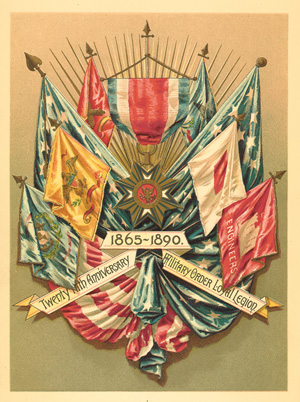
The California Commandery
The Commandery of the State of California was founded in 1871 with eight charter members. By 1915, it had on its rolls 21 Major Generals; 144 Brigadier Generals, 11 of whom were Brevet Major Generals; and 34 other officers who were Brevet Brigadier Generals; or, 204 who had won the right to be addressed as “General”; 54 Admirals and 1 Commodore. Of these 204 Generals, 357 received Brevets, 20 won Medals of Honor and two received the Thanks of Congress. The Commandery has had 95 members, not in the grade of General, who received one or more Brevets, and 21 of them also won the Medal of Honor. These 41 Medals of Honor generally meant something beyond ordinary bravery in the line of duty.
Once the combined membership of the twenty-one Commanderies of the Order was less than four times that who had been members of the California Commandery.
The Commandery has the only member who rose from the enlisted ranks to Rear Admiral.
It was one of its members who said at the moment of victory at Santiago: “Don’t cheer, men, while those poor fellows are dying.”
It was another of its Companions who took the Oregon on its 15,000-mile voyage from the Pacific to the Atlantic, arriving in time to render heroic service when Cervera’s fleet was destroyed; and it was two other Companions of ours who commanded on that historic day.
The California Commandery also currently serves Alaska, Arizona, Hawaii, Idaho, Oregon, Utah, Nevada and Washington.
Categories of Membership and Eligibility
Eligibility requirements in the various categories of membership are as follows:
- Hereditary -- Direct male descendants, age 18 or more, of a commissioned officer in the U. S. Army, Navy or Marines who served during the War of the Rebellion, or male descendants of a brother or sister of any such officer.
- Junior -- Direct male descendants under age 18 years of an eligible officer or of a brother or sister of any such eligible officer. Junior Companions cannot vote or hold office.
- Associate -- Male persons of the age of 18 or more who are not known to be eligible for Hereditary membership and who subscribe to the Preamble, Principles and Objects of the Order and
have demonstrated a serious interest in the War of the Rebellion, and whose membership will advance the objects of the Order may be elected as Associates by the various Commanderies. Associates may vote and serve on committees, but may not hold office.
- Honorary -- Bestowed by the Commandery-in-Chief and Commanderies under provisions of the Constitution and By-Laws.
Downloadable Forms
Application for Hereditary Membership with Instruction Sheet
California Commandery Information Brochure
Resources
The Sons of the Revolution Library has an extensive collection of references relating to the Civil War,
military history and genealogy. See its on-line catalog for specific
titles. Some of the library's extensive Civil War holdings include:
The Military Order of the Loyal Legion of the United States
70 volumes including 4-volume index
Originally published 1887-1915, "Civil War Books" calls this 70-volume set the finest collection of monographs and short personal sketches in the field of Civil War memoirs. Enhanced with illustrations, portraits, maps and plans,
this series contains first hand accounts of battles, leaders and campaigns written by the men who were there.
The volumes are entirely war content and do not feature advertisements or
editorials.
Publications of the Commandery-in-Chief
Journals, Proceedings, Annual Reports
Publications of various State Commanderies
Official Records of the Union and Confederate Navies During the War of the
Rebellion
30 volumes
The War of the Rebellion: A compilation of the Official Records of the Union and Confederate Armies
70 volumes
State Rosters and Adjutant's General Reports
If you are interested in references to identify possibly propositi, or interested in general genealogical research the SR Library is a place you should visit if possible.
An exciting book has been published that contains biographies and photographs of the original members of the Aztec Club of 1847, Military Society of the Mexican War.
Founded in Mexico City during the occupation by United States forces during the Mexican War (1846-1848),
the original members, numbering 160, represent most of the major figures of the Civil War.
On-line biographies of these Union and Confederate generals are contained at:
http://www.aztecclub.com
The Aztec Club's Sesquicentennial history, 1,500 pages, can be purchased at:
http://digitalclassics.walika.com
The MOLLUS Commandery in Chief web site is another resource to visit.
Civil War Library and Museum
In 1886, several Companions of the Loyal Legion began forming a Civil War Library and Museum to serve as a repository for their records, relics, memorabilia, souvenirs, artifacts and awards. A charter and Certificate of Incorporation were granted on May 2, 1888 for The War Library and Museum of the Military Order of the Loyal Legion of the United States. Companion Rutherford B. Hayes, nineteenth President of the United States, was its first elected President. The collection was kept in various locations in Philadelphia until a house was purchased at 1805 Pine Street in 1922 to house the collection and to serve as the Headquarters of the Loyal Legion.
Officers of the California Commandery
Commander
Richard Hoag Breithaupt, Jr.
Vice Commander
Bob Lowe
Treasurer
Robert Malott Fletcher, II
Recorder
Wayne J. Rogers